A Class 600 flange is not simply rated for 600 PSI. The “600” is a class designation. Its actual pressure capacity in PSI depends on two things: the flange material and the operating temperature.
You must use a pressure-temperature (P-T) rating table to find the correct PSI value. This table is found in the ASME B16.5 standard.
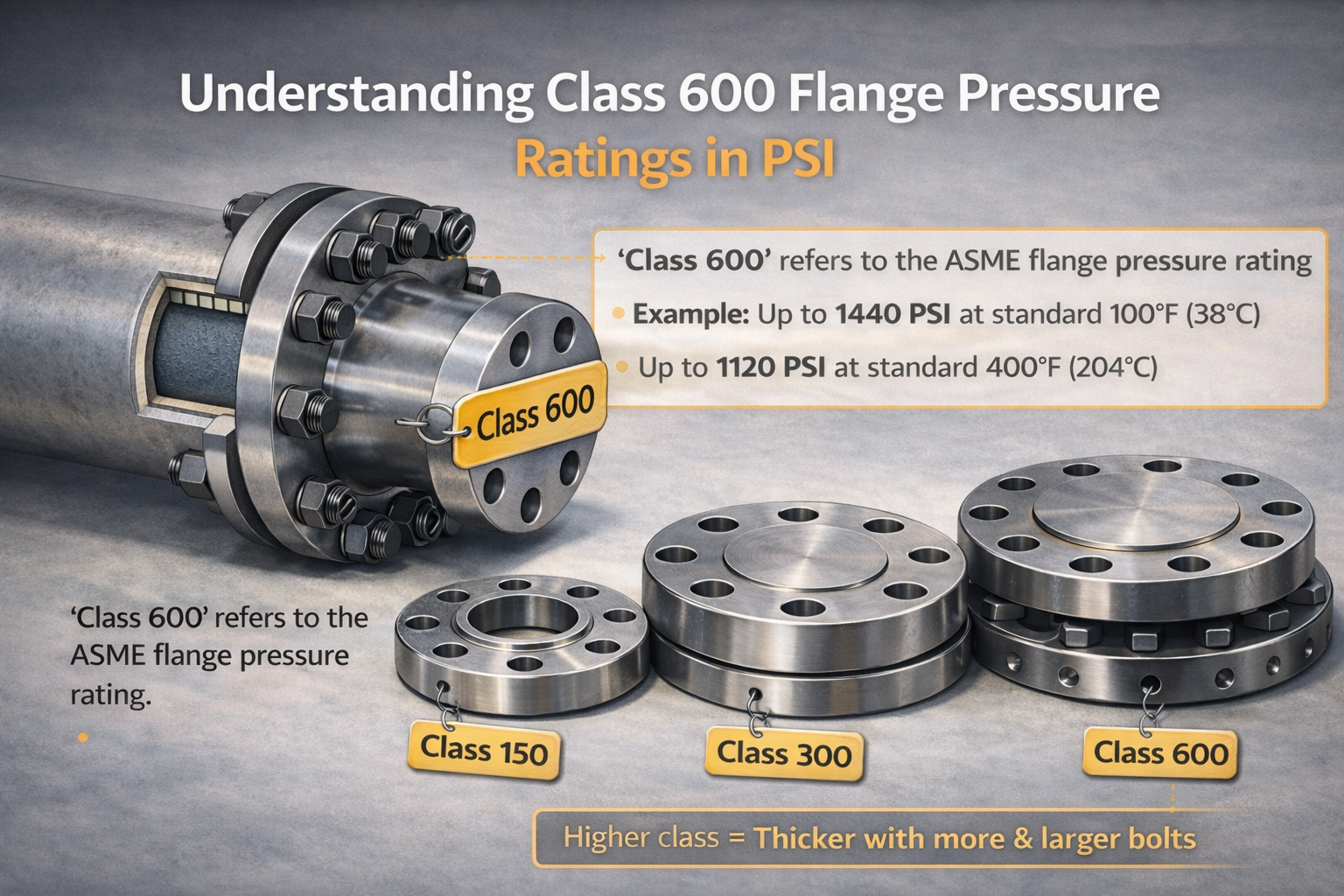
How Temperature Affects Pressure Rating
As temperature increases, the strength of the metal decreases. Therefore, the maximum allowed pressure goes down. A Class 600 flange can handle very high pressure at room temperature, but much less at high heat.
Class 600 Pressure Rating Tables (Per ASME B16.5)
The tables below show the maximum allowable non-shock working pressure in PSI. You must know your flange material and max operating temperature.
For Common Carbon Steel (ASTM A105) and Alloys
| Temperature (°F) | Max. Pressure (PSI) |
| 100°F | 1480 PSI |
| 200°F | 1350 PSI |
| 300°F | 1255 PSI |
| 400°F | 1155 PSI |
| 500°F | 1015 PSI |
| 600°F | 895 PSI |
| 650°F | 825 PSI |
For Common Stainless Steel (ASTM A182 F304/F316)
| Temperature (°F) | Max. Pressure (PSI) |
| 100°F | 1170 PSI |
| 200°F | 1065 PSI |
| 300°F | 1000 PSI |
| 400°F | 930 PSI |
| 500°F | 860 PSI |
| 600°F | 780 PSI |
| 650°F | 730 PSI |
Key Takeaway: At 100°F, a carbon steel Class 600 flange is rated for 1480 PSI, much higher than 600. At 650°F, its rating drops to 825 PSI. Always check the table.
How Class 600 Compares to Other Classes
The class number indicates relative strength. For the same material and temperature, pressure ratings scale with the class.
| Material: ASTM A105 at 100°F | Pressure Rating |
| Class 150 | 285 PSI |
| Class 300 | 740 PSI |
| Class 600 | 1480 PSI |
| Class 900 | 2220 PSI |
A Class 600 flange has roughly twice the pressure capacity of a Class 300 flange and five times that of a Class 150 flange at the same temperature.
Frequently Asked Questions
Q: Can I use a Class 600 flange for a 600 PSI system at 800°F?
A: No. You must check the rating at 800°F. The pressure rating at high temperatures is much lower. The system would be unsafe.
Q: Are these ratings the same for all flange types?
A: Yes, for standard types in ASME B16.5 (Weld Neck, Slip-On, Blind, etc.). The P-T ratings are based on the flange’s material and class, not its shape.
Q: What does “non-shock” pressure mean?
A: It means the rated pressure is for steady, sustained operation. It does not account for sudden pressure surges (water hammer). You need a safety margin for systems with potential shocks.
Q: My flange material isn’t listed here. How do I find its rating?
A: You must consult the full ASME B16.5 standard. It contains P-T tables for dozens of materials. Never guess the rating.
Q: What is the main advantage of a Class 600 over a Class 300 flange?
A: It can handle much higher pressure at the same temperature, or the same pressure at a much higher temperature. It is physically thicker and has more/larger bolts.
Conclusion
A Class 600 flange is for high-pressure or high-temperature service. Its actual pressure rating in PSI is not fixed. You must determine it using the correct ASME B16.5 pressure-temperature table for your specific flange material.
Need help selecting the right pressure class and material for your high-pressure system? Our technical team can ensure your specification is correct and safe.
Submit your temperature and pressure requirements for expert guidance and a quote: http://texasflange.com/lp12/